
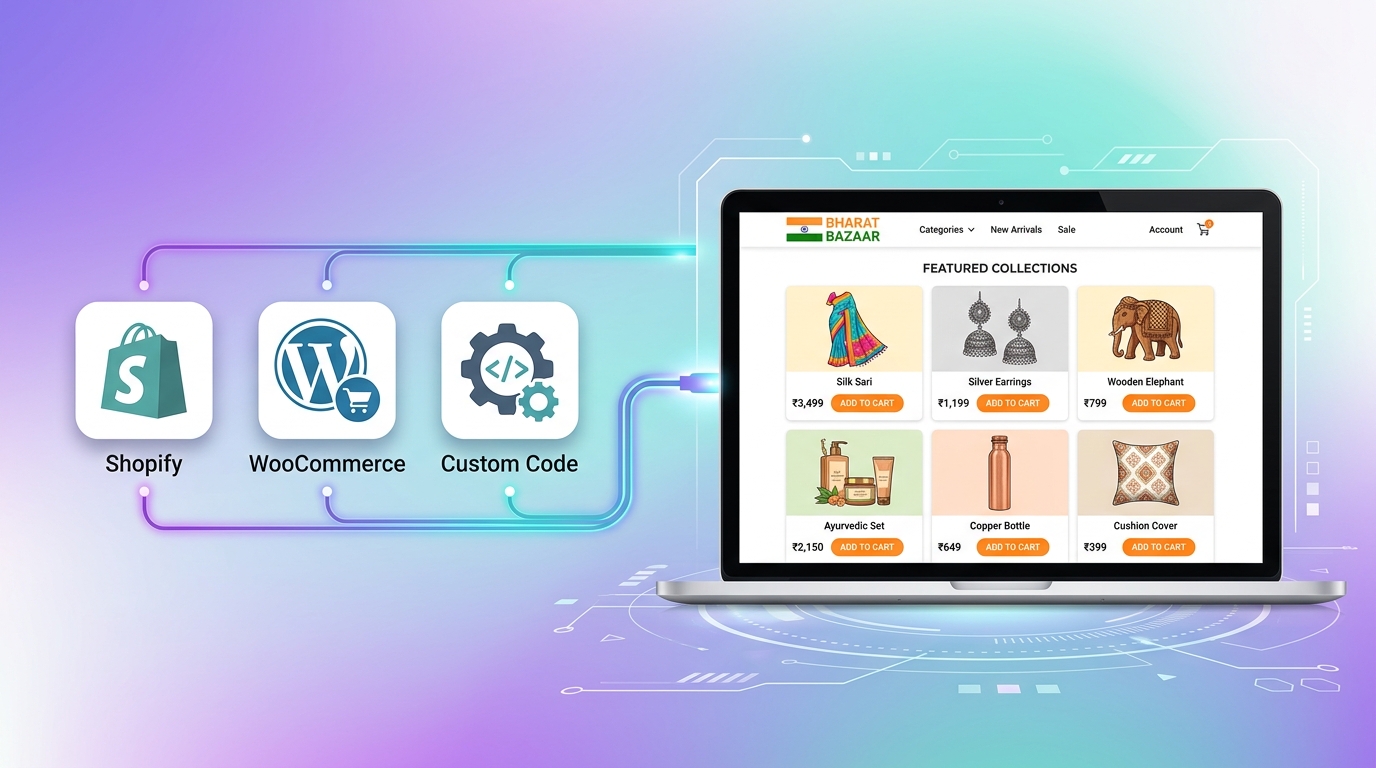
Best Ecommerce Platform for India 2026: Shopify vs Custom-Built Stores (Complete Comparison)
Choosing the right ecommerce platform is one of the most important decisions you’ll make as an online seller in India. Get it right, and your store scales smoothly as orders grow. Get it wrong, and you’ll spend the next two years fighting your own website instead of growing your business.
In 2026, Indian sellers have more choices than ever — Shopify, WooCommerce, Dukaan-style app builders, and fully custom-built platforms. Each comes with its own trade-offs around cost, control, and long-term scalability. This guide breaks down exactly what matters for the Indian market so you can make a decision with confidence.
Why the “Best Platform” Question Is Different for India
Global comparisons of ecommerce platforms often miss details that matter enormously for Indian sellers:
- Payment gateways: You need smooth integration with Razorpay, PayU, Cashfree, and UPI — not just Stripe or PayPal.
- Cash on Delivery (COD): Still a major payment method across tier 2 and tier 3 cities, and not every platform handles COD logistics well out of the box.
- GST compliance: Your invoicing, tax calculation, and reporting need to align with Indian tax law.
- Logistics integrations: Shiprocket, Delhivery, Ecom Express, and local courier partners need to plug in cleanly.
- Regional language and multi-currency needs: Increasingly relevant if you’re selling beyond metro cities or exporting internationally.
Keep these five factors in mind as we go through each platform — they matter more than generic “ease of use” scores you’ll find in most reviews.
Option 1: Shopify
Shopify remains one of the most popular choices for Indian ecommerce brands, especially those planning to scale internationally.
Strengths:
- Fast to launch — a store can go live in days, not weeks
- Reliable uptime and hosting handled entirely by Shopify
- Massive app ecosystem for reviews, upsells, email marketing, and more
- Increasingly good support for Indian payment gateways and INR pricing
Limitations:
- Monthly subscription plus transaction fees add up as your order volume grows
- Customization beyond a certain point requires hiring a Shopify developer, and modifying core checkout flow is restricted on lower plans
- Many “must-have” features are locked behind paid apps, which quietly increases your monthly cost
- You don’t fully own your platform — you’re building on rented infrastructure
Best for: Sellers who want to launch quickly, test a product-market fit, and don’t need deep customization in the first 1-2 years.
Option 2: WooCommerce (WordPress)
WooCommerce is the open-source alternative that runs on WordPress, and it remains popular among Indian small businesses and bloggers who already have a WordPress presence.
Strengths:
- No mandatory monthly platform fee — you pay for hosting and plugins only
- Massive flexibility since it’s open-source
- Large number of Indian-specific plugins for GST invoicing and local payment gateways
Limitations:
- You’re responsible for hosting, security, and updates — or you need a developer/agency to manage it
- Performance can degrade significantly under heavy traffic or large product catalogs unless properly optimized
- Plugin conflicts are common, and troubleshooting requires technical know-how
- Design customization is easier than Shopify’s, but still template-bound unless custom-coded
Best for: Sellers on a tight budget who have access to technical support and want more control without paying platform fees.
Option 3: Custom-Built Ecommerce Websites
A custom-built store — designed and developed specifically for your business — is the option most sellers overlook early on, usually because they assume it’s only for large enterprises. That’s no longer true in 2026.
Strengths:
- Complete ownership of your codebase, data, and infrastructure — no platform lock-in
- No recurring transaction fees or forced app subscriptions
- Built exactly around your product catalog, checkout flow, and customer journey rather than adapting to a template
- Scales precisely to your traffic and order volume without hitting artificial platform limits
- Easier to build unique features — subscription models, custom loyalty programs, B2B pricing tiers, marketplace-style multi-vendor setups — that off-the-shelf platforms restrict or charge heavily for
Limitations:
- Higher upfront development cost compared to a basic Shopify or WooCommerce setup
- Requires an experienced development team or agency, since you’re not relying on a pre-built ecosystem
- Slightly longer initial timeline to launch compared to a template-based store
Best for: Growing brands that have validated their product, expect meaningful order volume, and want a website that becomes a long-term business asset rather than a recurring monthly expense.
Side-by-Side Comparison
| Factor | Shopify | WooCommerce | Custom-Built |
|---|---|---|---|
| Upfront cost | Low | Low-Medium | Medium-High |
| Ongoing cost | Medium-High (fees + apps) | Low-Medium (hosting + plugins) | Low (mainly hosting/maintenance) |
| Customization | Limited without developer | Moderate | Full control |
| Scalability | Good, but cost scales with growth | Depends on hosting/optimization | Built to scale from day one |
| Ownership | Rented platform | Partial (self-hosted) | Full ownership |
| Time to launch | Fastest | Moderate | Longest |
| Best stage | Early-stage testing | Budget-conscious small stores | Growing/scaling brands |
How to Decide: A Simple Framework
Ask yourself these three questions:
- Am I still validating my product idea? If yes, Shopify or WooCommerce lets you launch fast and cheap while you learn what customers actually want.
- Do I already have consistent monthly orders and a clear growth plan? If yes, the recurring platform fees and customization limits of Shopify/WooCommerce start costing you more than a custom build would, especially over 2-3 years.
- Do I need features that don’t fit a standard template — custom pricing logic, unique checkout flows, multi-vendor setup, or deep integrations with your existing business software (accounting, inventory, CRM)? If yes, a custom-built platform is almost always the better long-term investment.
There’s no universally “best” platform — only the platform that’s best for your current stage and growth trajectory. Many successful Indian ecommerce brands actually start on Shopify or WooCommerce, then migrate to a custom-built platform once their order volume and feature needs outgrow what a template can offer cost-effectively.

Common Mistakes Indian Sellers Make
- Choosing a platform based on what a competitor uses, without evaluating their own catalog size, growth stage, or budget
- Underestimating the true cost of Shopify apps — many stores end up paying more in app subscriptions than the base Shopify plan itself
- Skipping COD and regional payment gateway setup early, then losing sales in tier 2/3 cities later
- Ignoring page speed and mobile optimization, which directly affects both conversions and Google rankings
- Migrating too early or too late — moving to a custom build before validating demand wastes money; delaying it too long means paying inflated platform fees during your highest-growth years
Frequently Asked Questions
Is Shopify better than WooCommerce for Indian sellers? Shopify is generally easier to manage since hosting and security are handled for you, while WooCommerce offers more flexibility at a lower base cost but needs more technical maintenance.
Is a custom-built ecommerce website expensive? The upfront cost is higher than Shopify or WooCommerce, but there are no recurring transaction fees or forced app subscriptions, which often makes it more cost-effective over 2-3 years for growing stores.
Can I switch platforms later without losing my data? Yes, though migration complexity depends on your product catalog size, order history, and integrations. Planning the migration with an experienced team minimizes downtime and data loss.
Which platform handles COD and Indian payment gateways best? All three options can integrate Razorpay, PayU, and COD logistics partners like Shiprocket, but custom-built platforms allow the smoothest, most tailored checkout experience since nothing is restricted by a template.
Final Thoughts
The right ecommerce platform depends entirely on where your business stands today and where you want it in the next two to three years. Shopify and WooCommerce are excellent starting points for testing and early growth. But once your order volume, customization needs, and long-term cost savings start pointing the other way, a custom-built platform typically delivers far better value — because you’re building an asset you fully own, not renting space on someone else’s system.
If you’re at the stage where you’re ready to move beyond template limitations, working with an experienced development team to build a platform tailored to your exact business needs is usually the smartest long-term move.